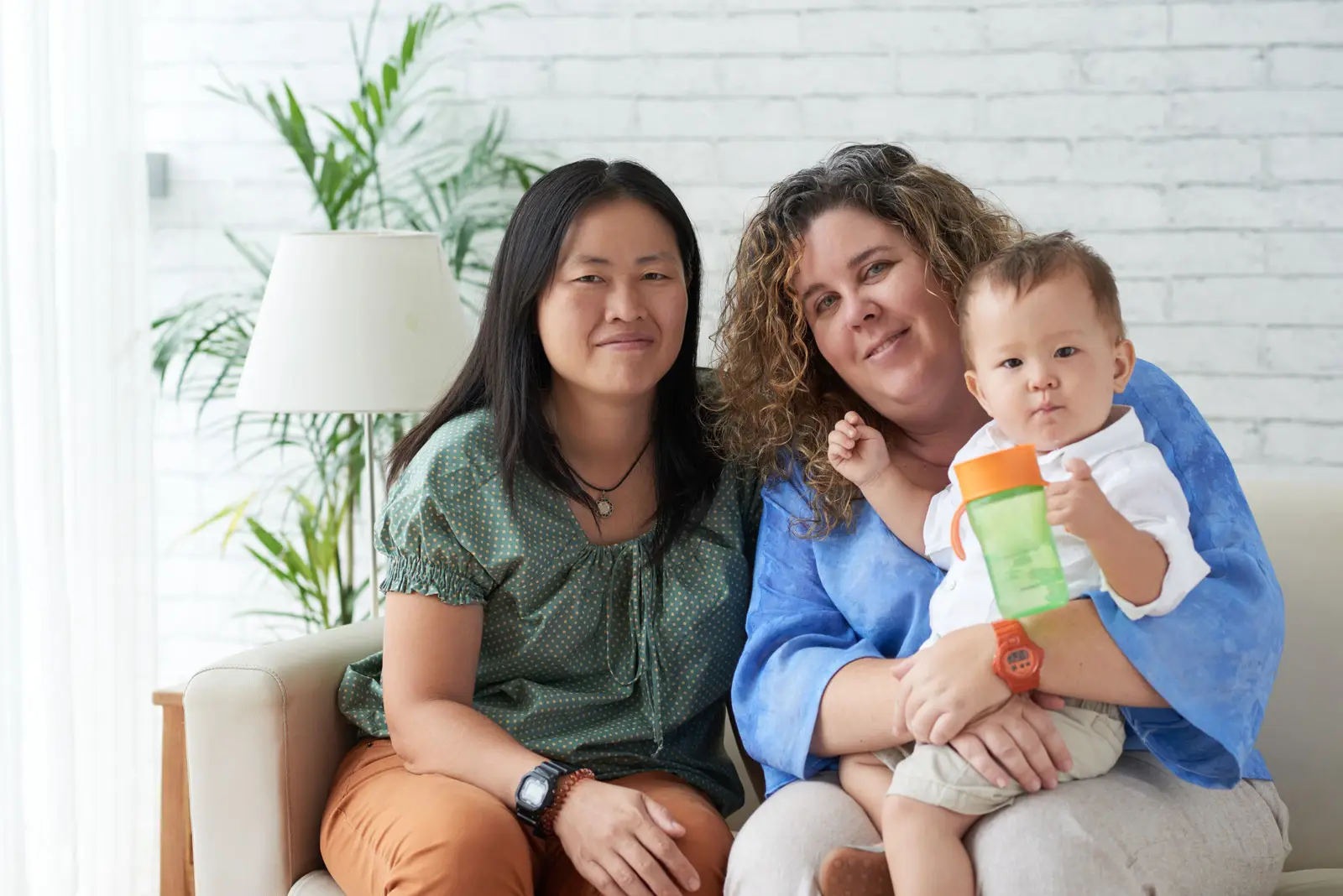
Building a family as an LGBTQ+ parent has never been more possible. Since LGBTQ+ marriage and adoption rights have expanded significantly in recent years, the law increasingly recognizes families like yours. Still, that recognition is strongest when it’s backed by the right legal steps—which is important if your family ever crosses state lines.
Knowing your rights is crucial for protecting yourself and your family. You should understand which adoption path is right for you, what the law guarantees, and what extra steps you can take to ensure you, your partner, and your kids are always in a place where the law strongly recognizes you as a family.
Federal Protections vs. State Variations in Same-Sex Adoption
Since the Supreme Court’s 2015 ruling in Obergefell v. Hodges, same-sex couples now have the right to marry nationwide, and with it, broader access to adoption. But marriage rights and the gay and lesbian adoption process still vary by state.
What carries a federal weight is the Full Faith and Credit Clause of Article IV, Section 1 of the U.S. Constitution. In simple terms, it requires states to recognize the judicial decisions and court orders of other states. The Supreme Court directly applied this in the V.L. v. E.L. (2016) case, ruling that a Georgia adoption decree issued to a same-sex couple had to be honored in Alabama, even though Alabama’s laws were less favorable.
This matters because a finalized adoption decree is a court judgment, not just a state administrative form. That’s why a properly finalized adoption is one of the strongest legal tools an LGBTQ+ family can have, no matter where life takes them next.
The Difference Between Joint, Second-Parent, and Step-Parent Adoption
Now that you’ve decided to adopt, the next step is figuring out which path fits your family. As a same-sex couple opting for adoption, you’ll need to know what type of adoption applies to your situation. The right option depends on your marital status and your relationship to the child. Here’s how the three primary paths break down:
Joint Adoption
Joint adoption is when two parents adopt a child together, at the same time, through a single legal process. In Ohio, married same-sex couples can pursue joint adoption together, just as married heterosexual couples can; both parents become legal parents simultaneously.
Step-Parent Adoption
Step-parent adoption applies when a married spouse adopts their partner’s biological or already-adopted child. In Ohio, this option became available to same-sex couples following Obergefell v. Hodges, and is often used when one partner gave birth to or adopted a child before the couple married. Once finalized, both spouses are listed as legal parents with full rights.
Second-Parent Adoption
According to Strauss Troy: Attorneys At Law, Ohio does not currently permit second-parent adoptions for unmarried couples, but for the sake of comparison, let’s define it. Second-parent adoption allows a non-biological, non-adoptive parent to gain legal parentage without the first parent giving up their rights. While it is not allowed in Ohio, it is currently available in roughly half of the U.S., and unmarried couples typically use it.
Why “Confirmatory Adoption” Matters Even With a Birth Certificate
Many LGBTQ+ parents assume that once both of their names appear on their child’s birth certificate, their parental rights are secure. Unfortunately, that’s not entirely true.
A birth certificate is a state-issued document for record-keeping, while a court adoption decree is a judicial order recognized across state lines. A birth certificate indicates parentage but is not as definitive as a court order.
This is where LGBTQ+ adoption rights become especially concrete—through confirmatory adoption (sometimes used interchangeably with second-parent or step-parent adoption, depending on your state and marital status). Even if you’re already listed on your child’s birth certificate, completing a confirmatory adoption gives you:
A court order that must be recognized in all 50 states, regardless of local law
Protection if your family travels or relocates to a state with less favorable laws
Security in emergencies, hospital visits, school decisions, and medical consent
Clarity in the event of separation, divorce, or the death of the other parent
Peace of mind that your parental rights cannot be challenged later
If you’ve never completed this extra legal step, it’s worth discussing with an attorney, even if your name is already on the birth certificate.
Protecting Your Rights During the Home Study Process
If your path to parenthood includes adoption through an agency, you’ll go through a home study. It is an assessment conducted by a certified adoption assessor to evaluate your readiness to adopt. This is a standard part of the process for every prospective parent, regardless of your sexuality.
You have the right to a fair, respectful, and unbiased home study. A good agency will:
Treat your relationship and family structure with the same respect given to any other family
Avoid assumptions or judgments based on your sexual orientation or gender identity
Use inclusive language and documentation that reflects your actual family
Connect you with LGBTQ-affirming professionals when needed
If at any point the process doesn’t feel respectful or fair, you have every right to ask questions or seek a different service provider. Choosing an LGBTQ-friendly adoption agency, like Open Arms Adoptions, can help you feel supported during this part of the journey.
Essential Legal Documents Every Same-Sex Parent Should Have
Beyond the adoption decree itself, there are a few key documents every LGBTQ+ parent should have in place to protect their family’s medical, financial, and legal interests:
Finalized adoption decree: your strongest, most universally recognized form of legal parentage
Medical consent authorization forms: allowing both parents to make healthcare decisions for the child, especially important during travel or emergencies
Guardianship and emergency custody documentation: designating who can care for your child if both parents are unavailable
Wills and parental designation documents: clarifying custody and guardianship wishes if something happens to one or both parents
Having these documents in place isn’t about expecting the worst. It’s about making sure your family’s stability doesn’t depend on which state you’re in when something unexpected happens.
How Open Arms Supports LGBTQ+ Families in Adoption
At Open Arms Adoptions, every family is welcome here, full stop. Your sexual orientation is not, and never should be, a disqualifying factor or a barrier keeping you from building the family you want.
Here’s how we support LGBTQ+ families through the adoption journey:
Offer inclusive, judgment-free support for every family type
Provide guidance through paperwork, training, and the home study process
Connect families with legal protections for LGBTQ parents, resources, and community support
Walk alongside you through both the emotional and legal stages of adoption, with clarity instead of confusion
With Open Arms Adoptions, you’re never navigating this journey alone.
Frequently Asked Questions
It depends on the adoption type, but most finalizations, including joint adoptions, take a few months once paperwork and any required home study are complete. Your attorney or adoption counselor can give you a timeline specific to your situation.
Yes, once the adoption is finalized through the court. A finalized adoption decree grants both parents full legal rights, unlike simply being named on a birth certificate, which doesn’t carry the same legal weight.
Yes. Adoption procedures vary by state, but the Full Faith and Credit Clause requires every state to recognize a valid adoption decree issued in another state. If you’re adopting in one state and may relocate, confirm the details with an attorney first.
A non-biological or non-adoptive parent’s relationship to the child may not be recognized in situations like separation, medical emergencies, or a move to a less favorable state. This is exactly why confirmatory adoption matters, even when both parents are already listed on the birth certificate.
Finalize a court adoption decree. It’s the strongest protection available, recognized nationwide under the Full Faith and Credit Clause. Add medical consent forms, guardianship documentation, and an updated will for layered protection, wherever you live or travel.
Securing Your Family’s Future With Confidence
LGBTQ+ adoption rights have come a long way, and your family deserves every bit of the legal security that comes with it. To protect your family, you need to take proactive steps rather than make assumptions. Seeking clear information is not being overly cautious; it’s a responsible approach that every parent should take.
The legal system, while not without its gaps, increasingly supports diverse family structures, and a properly finalized adoption remains one of the most powerful tools you have to secure that recognition everywhere you go. Open Arms Adoptions is here to help your family move forward with the confidence and protection you deserve.
Reviewed By
Jackie Smigel
Founder and Executive Director, Open Arms Adoptions
Jackie Smigel is the Founder and Executive Director of Open Arms Adoptions, a 501(c)(3) nonprofit adoption agency licensed by the State of Ohio, with offices in Kent, Columbus, and Delaware. She has worked in adoption for more than 30 years and continues to carry her own caseload alongside leading the agency, which places children through infant adoption, foster care adoption, and special needs adoption, and supports expectant parents considering their options. Her work keeping and reuniting sibling groups led AdoptUSKids to recognize her as an Outstanding Caseworker in 2022, on the nomination of a mother she helped adopt three siblings together.
Read More Articles
How to Prepare Your Biological Children for an Adopted Sibling
Keep it honest, simple, and age-appropriate. Tell them a new brother or sister is joining your family, invite their questions, and validate all of their feelings. Match the details to their age, and protect the new sibling’s private story when you talk with others, including children already in your family.
Adoption After IVF: Knowing When You’re Ready to Start a New Journey
Readiness looks different for everyone, but some common signs include feeling genuinely curious about adoption, imagining parenthood outside of pregnancy, and noticing that hope is slowly returning. You don’t need to feel fully healed. Emotional readiness is a gradual shift, not a sudden decision.
Finding Hope in Adoption After Miscarriage
There is no required waiting period; readiness is personal, not time-based. What matters most is that you’ve had space to grieve and feel genuinely open to exploring a new path. Some families move toward adoption within months; others take years. Both are valid.
Creating Forever Families
Creating Forever Families Through Adoption
Open Arms Adoptions is 501(c)3 non-profit agency licensed by the State of Ohio.
Our mission is to provide a loving, stable home to every child in need. We work tirelessly to create an environment that embraces the unique set of circumstances each of our birth parents, prospective adoptive parents and children bring to us.